
If you would like to discuss this report,
you can contact
Joan.Henry@ie.knightfrank.com
or
Robert.OConnor@ie.knightfrank.com
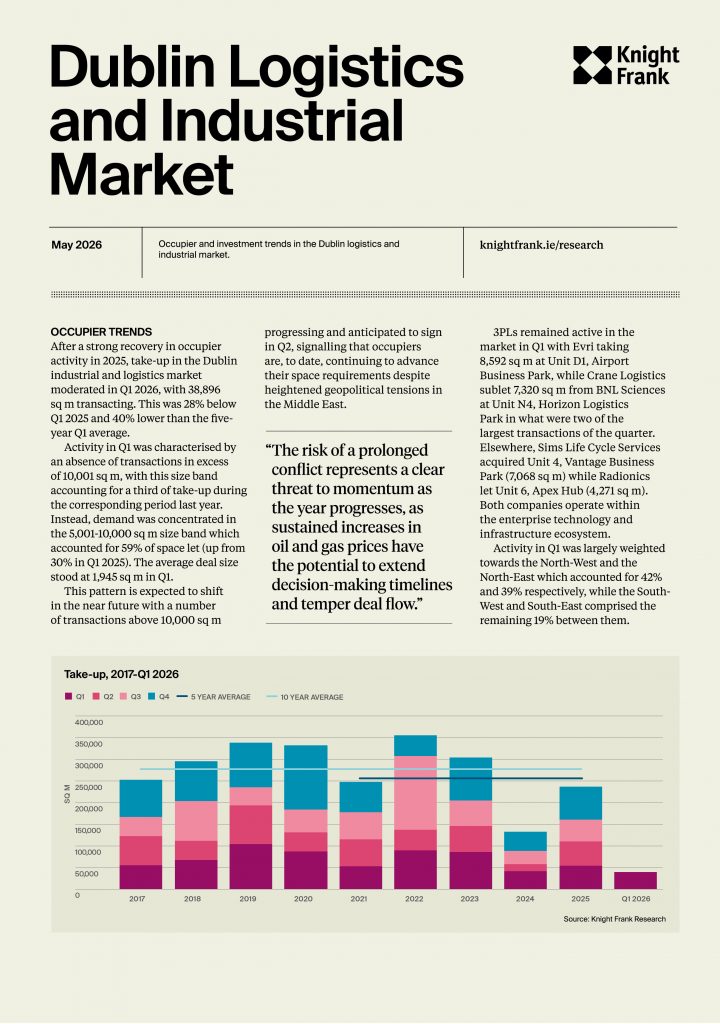
- Dublin industrial and logistics take-up reached 38,896 sq m in Q1 2026. This was a subdued start to the year as activity was 28% below Q1 2025 and 40% lower than the five-year Q1 average.
- While activity in Q1 was characterised by an absence of deals in excess of 10,001 sq m, we are aware of a number of transactions that are progressing and which should sign in Q2, signalling that occupiers are continuing, to date, to advance their space requirements despite the conflict in the Middle East.
- Nevertheless, a prolonged conflict creates a risk to momentum as the year progresses, as sustained increases in oil and gas prices have the potential to extend decision-making timelines.
- Vacancy in Dublin rose to close to 3% following new speculative completions, although availability remains historically low and heavily weighted towards older second-hand stock.
- Development activity remains constrained, with just 69,000 sq m currently under construction across Dublin. Extended conflict in the Middle East could have a material impact on construction inflation and debt costs, further constraining speculative development going forward.
- Investment volumes totalled €36.4m in Q1, led by State Street’s €33.2m acquisition. Prime industrial yields remained steady at 5.00%. Robust occupier fundamentals appears to have mitigated some of the potential fallout from geo-political asset repricing.
- The special focus highlights how Dublin’s warehouses are getting taller, with average clear heights rising from 12.0m in 2018 to a projected 14.0m in 2026 as occupiers seek greater efficiency, automation capability and storage density.