
Average warehouse clear heights in Dublin are projected to hit 14 metres this year.
New research from Knight Frank Ireland shows that Dublin’s logistics and industrial buildings are becoming taller as occupiers seek to maximise storage capacity and improve operational efficiency.
According to the latest research from Knight Frank Ireland, average warehouse clear heights in Dublin have increased from 12.0 metres in 2018 to a projected 14.0 metres in 2026 on a weighted basis by floorspace, highlighting a clear shift towards taller, higher-specification logistics buildings.
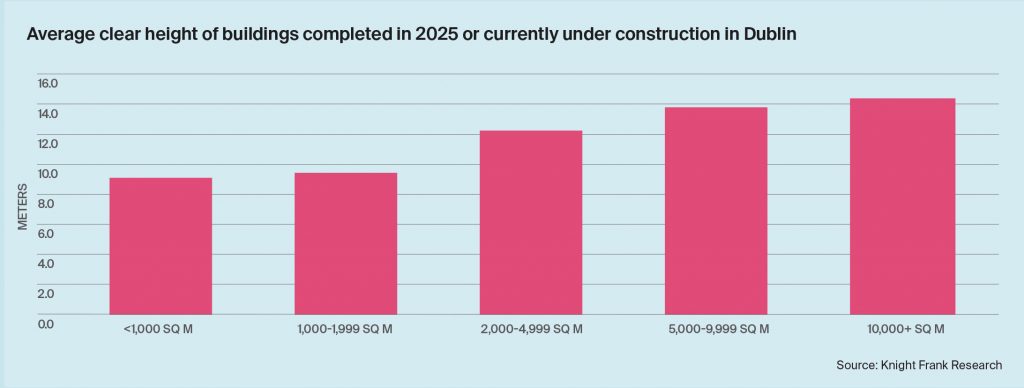
The trend is most evident in larger units. For schemes completed in 2025 and currently under construction in Dublin, average clear heights range from 9.1 metres for units below 1,000 sq m to 14.4 metres for units above 10,000 sq m.
Robert O’Connor, Divisional Director, Research at Knight Frank Ireland, said: “Taller warehouses allow occupiers to increase pallet capacity, improve operational efficiency and support greater levels of automation, while at the same time maximising increasingly scarce industrial land.”
The research identifies several factors driving the move towards taller logistics buildings.
Greater clear heights allow operators to increase storage density and pallet capacity, which is particularly important for e-commerce businesses managing broad product ranges and fluctuating inventory levels.
A reduced footprint also lowers operational costs, as smaller roof and floor areas require less energy for cooling and temperature control, an important consideration for cold storage facilities. Finally, advancements in automation technology, make ultra-high-bay storage feasible, unlocking efficiencies that manual operations cannot achieve.
“Height is becoming a much more important consideration from both an occupier and investor perspective.”
The report notes that taller, well-specified warehouses can support stronger rental growth and capital values by enhancing occupier demand, improving operational resilience and reducing long-term obsolescence risk.
However, the research also highlights practical limitations to warehouse height expansion.
Costs and engineering complexity rise significantly at higher levels, with stricter structural and fire safety requirements. Planning restrictions and public scrutiny can also limit height. Additionally, taller buildings often require specialised automation and material-handling equipment which can be prohibitively expensive. Not all occupiers need extra height either, as some operations function efficiently with lower clear heights.
Robert O’Connor added: “While height is not the primary driver of value, it enhances occupier demand, reduces obsolescence risk and supports more resilient long-term income for investors and developers.”
The findings form part of Knight Frank Ireland’s Dublin Logistics & Industrial Market Report Q1 2026.